WEEK 01 · CHAPTER 01
How Historians Think
The past is enormous. The evidence that survived is not.
SECTION 1
The Past and History
What is the difference?
Everything that ever happened is the past.
The breakfast you ate this morning is part of the past. So are the pyramids, yesterday’s argument, the first human footsteps, and every life that ended without leaving a written name.
History is the story we build about the past using evidence.
Evidence can be a letter, photograph, tool, building, law, map, recording, story passed from one generation to another, or something else that survived. A story passed down by speaking and listening is called oral history.
YOUR TURN
A family records a grandparent describing life in another country before moving to Canada. What kind of evidence have they preserved?
Modern humans have existed for about 300,000 years. Writing appeared only around 5,000 years ago. Most human lives therefore left no written record at all.

One of the oldest surviving written names may be Kushim. The name appears on tablets connected to barley. Kushim may have been a person, a job title, or the name of an office. We cannot be completely sure, and that uncertainty is honest history.
TRY IT · THE SURVIVAL GAP
Move through human time
At 300,000 years, written names cover less than two percent. The rest of the past did not disappear completely, but historians must use other evidence such as objects, places, art, human remains, and oral history.
YOUR TURN
Which sentence best explains the relationship?
SECTION 2
Historical Significance
Why do some parts of the past receive more attention?
Something is historically significant when it had an important impact on people’s lives.
Three questions make that idea easier:
How strongly were people’s lives changed?
How many people or communities were affected?
Did the consequences end quickly, or do they reach into the present?
OLD LETTER
“Please buy milk.”
This letter is evidence of one ordinary moment. It may matter deeply to a family, but by itself it probably did not change many lives.
INDIAN ACT · 1876
A law with enormous reach
The Canadian government used the Indian Act to control major parts of First Nations life, including legal identity, leadership, land, and cultural practices. It affected generations, and the law still exists today in amended form.
The Indian Act is historically significant because its impact was deep, wide, and long-lasting. The ordinary letter is still a primary source, but being old does not automatically make something historically significant.
YOUR TURN
Which discovery would most increase the significance of the milk letter?
YOUR TURN
Which is the strongest argument that an event is significant?
SECTION 3
Cause, Consequence and Perspective
History makes more sense when the examples come first.
Major events usually have several causes. One event may trigger the crisis, but deeper conditions made the crisis possible.
EXAMPLE 1 · HOW THE FIRST WORLD WAR BEGAN
Imperial powers competed for colonies, resources, and influence.
Militarism produced enormous armies, navies, and war plans.
Alliances divided Europe into rival armed camps.
Nationalism intensified rivalries inside and between empires.
A Bosnian Serb nationalist assassinated Archduke Franz Ferdinand, heir to the Austro-Hungarian throne, on 28 June 1914.
Austria-Hungary attacked Serbia. Russia mobilized. Germany declared war on Russia and France and invaded Belgium. Britain entered the war, automatically bringing Canada with it.
THE CONSEQUENCES DID NOT STOP IN 1918
One war changed the entire century
The fighting killed millions of soldiers and civilians, wounded millions more, and left communities grieving across Europe and beyond. The Russian, German, Austro-Hungarian, and Ottoman empires fell. New countries appeared on maps, but many borders placed different peoples inside unstable states.
In Russia, war helped produce revolution and the creation of the Soviet Union. In Canada, wartime production expanded industry, the federal government introduced income tax, and women gained new political and economic roles. At the same time, the 1917 conscription crisis divided English and French Canada and left political bitterness that lasted for years.
The peace was unstable. The Treaty of Versailles blamed Germany for losses caused by the war and imposed reparations. The settlement did not single-handedly cause the Second World War, but humiliation, economic crisis, political violence, fear of communism, and unresolved nationalism gave Adolf Hitler and the Nazi movement conditions they could exploit. The Canadian War Museum describes the result bluntly: the peace helped set the conditions for fascist dictators and another world war.
AFTER THE WAR · CANADIAN WAR MUSEUM“The First World War ended in a complete Allied victory but an unstable peace.”
Canada and the First World War, Canadian War Museum
YOUR TURN
Which chain best shows a long-term consequence of the First World War?
YOUR TURN
If the assassination had not happened, would all the deeper tensions have disappeared?
EXAMPLE 2 · THE RAILWAY THAT ATTEMPTED TO HOLD A COUNTRY TOGETHER
The new Dominion stretched across enormous distances with few fast land connections.
British Columbia demanded a railway link before joining Canada in 1871.
Canadian leaders feared American expansion toward the Pacific.
Business and government wanted western land, resources, settlers, and trade connected to eastern markets.
The government granted land, money, and support to the Canadian Pacific Railway, and construction accelerated under William Van Horne.
On 7 November 1885, the last spike completed the first continuous Canadian transcontinental railway.
A RIBBON OF STEEL WITH TWO STORIES
The railway helped create modern Canada. It also carried conquest west.
For the federal government, the railway was nation-building on an almost unbelievable scale. It made the promise to British Columbia real, moved people and goods across the continent, connected western resources to eastern factories and ports, and allowed Ottawa to move soldiers, officials, mail, settlers, and law more quickly. Winnipeg became the “Gateway to the Canadian West.” Prairie towns and cities grew around stations. Railway companies promoted immigration, tourism, mountain hotels, and the settlement of farmland.
The line also helped transform a political idea called Canada into a country people could physically cross. Shared railway time standardized clocks. Newspapers, products, migrants, soldiers, and political decisions travelled faster. The railway did not create Canadian unity by itself, but without a transcontinental link, holding a country of this size together would have been far more difficult.
That national story came at a devastating cost. Railway lines crossed First Nations territories without consent and supported a larger colonial project of surveys, reserves, policing, resource extraction, and mass settlement. Library and Archives Canada notes that about 5,000 First Nations and Métis people were expelled from the Cypress Hills during construction. The same trains that connected Canada also helped newcomers occupy Indigenous lands.
Chinese labourers performed much of the most dangerous work in British Columbia. Parks Canada records that about three-quarters of the workers on the western section were Chinese. They often earned about half the pay of white workers. Hundreds died in explosions, rockslides, disease, drowning, and camps with poor food and little medical care. After completion, the federal government imposed a discriminatory head tax on Chinese immigrants.
PRIMARY SOURCE · BRITISH COLUMBIA TERMS OF UNION · 1871Canada promised to begin a railway connecting British Columbia with the Canadian rail system and complete it within ten years.
Clause 11, British Columbia Terms of Union, paraphrased for clarity
OFFICIAL COMMEMORATION · PARKS CANADAChinese workers received about one dollar a day, roughly half the pay of a white worker, while hundreds died from accidents or illness.
Chinese Construction Workers on the Canadian Pacific Railway National Historic Event
YOUR TURN
Why can the railway be both a nation-building achievement and an instrument of colonial harm?
YOUR TURN
Which statement best explains the railway’s consequences?
Perspective means seeing the event from someone’s position
A Roman emperor, an enslaved worker, and a conquered community could all describe the Roman Empire differently. Their accounts would differ because they had different power, knowledge, and experiences.
YOUR TURN
The Great Wall is being built. Which source would best help us understand the experience of forced labourers?
Ethical thinking means asking whether actions were right or wrong
We first learn what people knew, believed, and could choose at the time. Then we examine harm, power, resistance, and responsibility. People in the past often disagreed with injustice, so “everyone thought that way” is rarely a good answer.
Who was John A. Macdonald?
Macdonald was Canada’s first prime minister and a central figure in Confederation. His governments helped build the country and the railway. They also expanded policies designed to control and assimilate Indigenous peoples.
Residential schools separated Indigenous children from their families, languages, and cultures. The schools were funded by the government and often operated by churches. Many children experienced neglect, abuse, illness, and death.
PRIMARY SOURCE · HOUSE OF COMMONS · 1883“Indian children should be withdrawn as much as possible from the parental influence.”
Prime Minister John A. Macdonald, explaining the purpose behind residential-school policy
This quotation tells us what Macdonald argued. It does not tell the whole history. We also need testimony from survivors and families, school records, government and church documents, and evidence from people who opposed these policies.
YOUR TURN
Why is the quotation important evidence?
SECTION 4
Using Evidence: Vimy Ridge
Learn the battle first. Then investigate the sources.
Before we analyse evidence, we need to know what happened.
Vimy Ridge in one minute
The First World War began in 1914. Germany and its allies fought Britain, France, Canada, and other Allied countries. In northern France, German forces held a long, high ridge near the town of Vimy. From the ridge they could observe and defend the surrounding land.
French and British attacks had failed to take it. On 9 April 1917, all four divisions of the Canadian Corps attacked together. Canadians trained carefully, studied maps and models, dug tunnels, and followed a moving line of artillery fire called a creeping barrage. After four days, they controlled the ridge. More than 10,600 Canadians were killed or wounded.
The battle later became a powerful story about Canada’s growing independence. It also grew from changes already underway before 1914: Canada’s relationship with Britain, military preparation, immigration, industry, and national identity.
YOUR TURN
Why did the ridge matter militarily?
A primary source was created during the time being studied. A secondary source was created later to explain or interpret the past.
YOUR TURN
Which is a primary source for the battle?
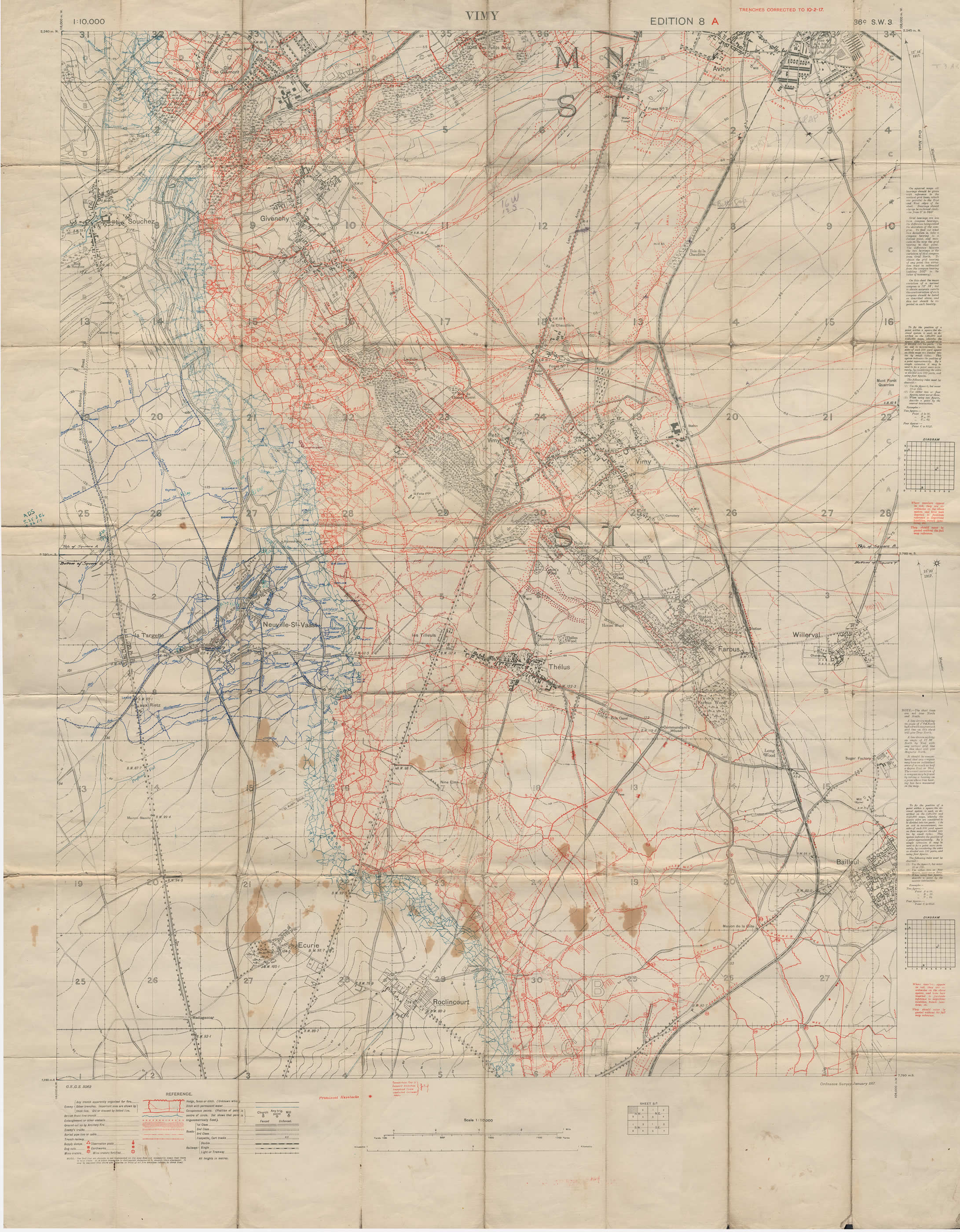
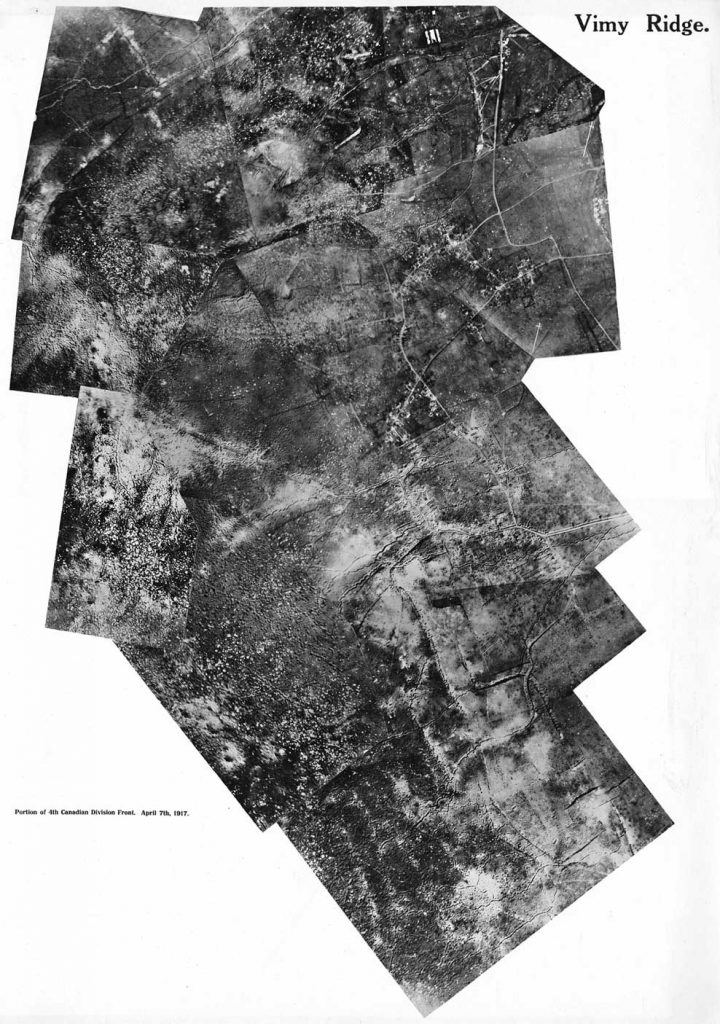
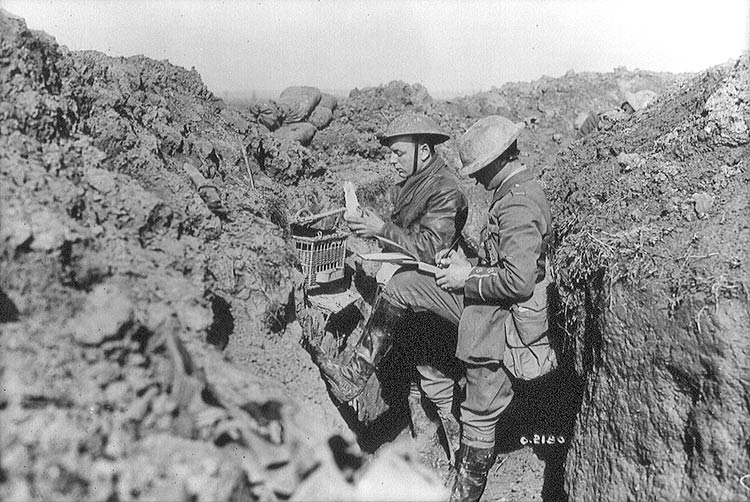
READ THE THREE SOURCES
Which claim do all three sources support?
SOURCE D · FIELD MESSAGE · 9 APRIL 1917
“I am afraid we have had rather serious casualties.”
Captain Thain MacDowell reported during the attack that his company had reached its objective. Only fifteen men were with him in what he called a “horrible mess.” He requested reinforcements and machine-guns.
Why it matters: this message shows that a carefully planned battle could still become deadly and chaotic.
Open the Canadian War Museum record ↗YOUR TURN
Which statement is a fact directly stated in the field message?
SOURCE E · LETTER HOME · 12 APRIL 1917
A survivor writes to his parents
Lieutenant Alvin Thomas Kines wrote home three days after the assault. He told his parents he had survived and mentioned friends who had been wounded or killed.
Why audience matters: someone writing to worried parents may choose different details than someone reporting to a commanding officer.
Open the archival record ↗YOUR TURN
What is a reasonable inference about Kines’s letter?
FINAL INVESTIGATION
Can these sources prove that every soldier understood the battle plan?
The map, aerial photograph, and training photograph prove that the attack was carefully prepared. MacDowell’s message shows what happened to one company during combat. Kines’s letter shows one survivor communicating with his family.
Reveal the most defensible conclusion
The sources strongly support careful planning, but they cannot prove what every soldier understood. We would need evidence from many soldiers of different ranks and units.
Show what you understand
Choose an answer for each question. You will receive an explanation after checking.
You should now be able to…
Explain the difference between the past and history.
Judge significance by asking how deep, wide, and long-lasting the impact was.
Separate deeper causes from an immediate trigger.
Explain why consequences can be different for different groups.
Use a person’s position and experience to understand perspective.
Distinguish a primary source, fact, and inference.
Compare sources before drawing a conclusion.
The questions throughout the chapter and the eight-question self-check are your evidence that you can do these things. If one still feels unclear, use the section links at the top and try its question again.